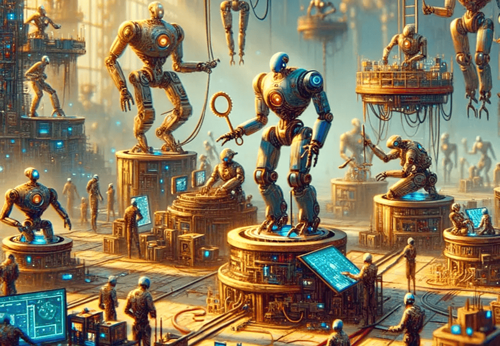
Collaborative robots (Cobots)
Human robot teams: cobots will work alongside humans in factories, hospitals, and homes, enhancing productivity and safety.
Adaptive interaction: improved sensors and AI will allow robots to understand human gestures, emotion and speech more naturally.
Soft robotics & bio-hybrid systems
Flexible & safe robots: soft robotics, inspired by biology will enable safer interactions in medical and care giving applications.
Biohybrid robots: combining living tissues with synthetic components could lead to robots with self-healing or adaptive capabilities.
Swarm robotics
Collective intelligence: large groups of simple robots will collaborate to perform complex tasks (e.g. search & rescue, agriculture, construction).
Decentralized control: inspired by ants and bees, swarm robotics will enable scalable, resilient systems.
Medical & healthcare robotics
Surgical precision: AI assisted robotic surgeons will perform minimally invasive procedures with superhuman accuracy.
Nanobots: microscopic robots could deliver drugs, perform diagnostics or even repair cells.
Autonomous vehicles & drones
Self driving cars & trucks: fully autonomous transportation will revolutionize logistics and urban mobility.
Delivery drones: air and groun based robots will handle last mile deliveries in cities and remote areas.
Space & exploration robotics
Mars & Lunar Rovers: robots will build habitats, mine resources and conduct research in space.
Autonomous space probes: AI driven robots will explore distant planets and asteroids without human intervention.
Ethical & societal implications
Job displacement vs. creation: automation will replace some jobs but also create new roles in robot maintenance, programming and supervision.
Regulation & safety: governments will need policies for AI ethics, robot rights and liability in accidents.
Human robot relationships: as robots become more lifelike, ethical questions about emotional bonds and rights will arise.
Energy & sustainability
Green robotics: energy efficient designs and solar powered robots will support sustainability.
Environmental clean up: robots will help with pollution control, ocean clean up and reforestation.
Personal & home robotics
Domestic helpers: robots will handle chores (cleaning, cooking, gardening) in smart homes.
Companion robots: social robots may provide emotional support and entertainment.
Challenges
Technical: improving battery life, dexterity and real time decision-making.
Economic: high costs of development and deployment.
Security: preventing hacking and misuse of autonomous systems.
Ethical: ensuring robots align with human values and do not reinforce biases.
The future of robotics is bright but complex, blending cutting edge technology with societal adaptation. As robots become more integrated into daily life, interdisciplinary collaboration (engineers, ethicists, policymakers) will be crucial to shaping a future where robotics benefits all of humanity.