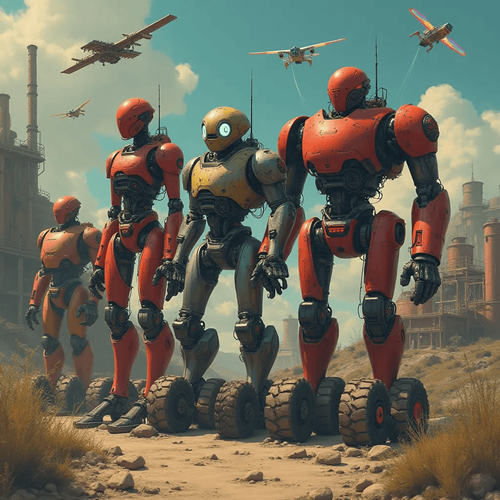
Advantages & Disadvantages
Humanoid (Tesla Optimus, Figure 01, Atlas)
Advantages
Works in human environments (stairs, doors, tools).
Social acceptance (easier interaction in healthcare, customer service).
Versatile manipulation (hands with fingers can use existing tools).
Disadvantages
Mechanically complex (balance, joints, power hungry).
Expensive to build and maintain.
Energy inefficient (bipedal walking is less stable than wheels).
Best for: service robots, care giving, human collaboration.
Quadruped/dog like (Boston Dynamics Spot, Unitree Go1)
Advantages
Superior stability (four legs handle rough terrain better than bipeds).
Faster and more efficient than bipeds (though slower than wheels).
Lower centre of gravity (better for carrying loads).
Disadvantages
Limited manipulation (no hands, often requires add-ons).
Less intuitive for human interaction.
Still power hungry compared to wheels.
Best for: inspection, search & rescue, military recon.
Wheeled/Tracked (Amazon Astro, Delivery Robots)
Advantages
Most energy efficient (great battery life).
High speed on flat surfaces.
Disadvantages
Poor on stairs/uneven terrain.
Limited manipulation (usually no arms).
Best for: logistics, indoor delivery, surveillance.
Hybrid (Wheeled Legs, Agility Digit)
Advantages
Best of both worlds (wheels for speed, legs for obstacles).
Adaptable to mixed environments.
Disadvantages
Complex design (higher failure risk).
Heavier and more expensive.
Best for: warehouses, last mile delivery.
Serpentine/Snake (Search & Rescue Robots)
Advantages
Fits in tight spaces (pipes, rubble).
Highly flexible movement.
Disadvantages
Very slow.
No manipulation ability.
Best for: Disaster recovery, pipe inspections.
Drone/Flying (Skydio, Autonomous Drones)
Advantages
Omits ground obstacles entirely.
Fast aerial surveillance.
Disadvantages
Short battery life (although some are being extended)
Limited payload capacity.
Best for: mapping, delivery in open areas. Used exrensively in modern warfare.
Non-biological (Modular, Swarm Robots)
Advantages
Reconfigurable for tasks (e.g. self assembling bridges).
Scalable via swarming. Popular with warfare designers.
Disadvantages
No standardized design yet.
Weak individual capabilities.
Best for: Space construction, adaptive structures, overwhelming resistance.
Which Shape is "Best"
Home assistant - Humanoid - Uses human tools, social acceptance.
Factory logistics - Wheeled + Arm (like Stretch) - Speed + manipulation.
Disaster rescue - Quadruped or Serpentine - Rough terrain, stability.
Autonomous delivery - Wheeled - Energy efficiency.
Military recon - Quadruped or Drone - Stealth, all-terrain.
Future Trends
Humanoids will dominate service roles (due to environment compatibility).
Quadrupeds will remain niche for rugged tasks.
Wheeled robots will win in logistics (cheaper, more reliable).
Flying/swarm robots will expand in inspection/construction.